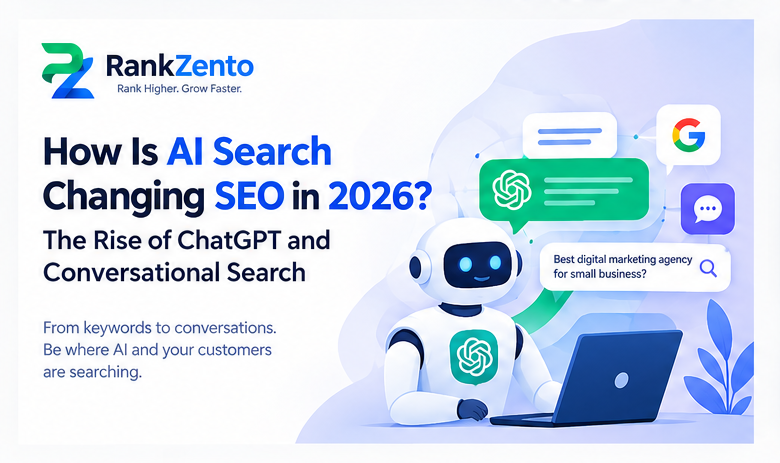
Search is no longer limited to typing a few keywords into Google and choosing a link from a list of results. People now ask detailed questions, describe problems in natural language, compare products through AI tools, and expect direct answers. This shift is changing how businesses approach search visibility and how SEO professionals create content.
In 2026, AI SEO is becoming an important part of modern search strategy. Tools such as ChatGPT and Google’s AI-powered search features are changing how users discover information, evaluate businesses, and decide what to click. Traditional SEO still matters, but businesses now need to think beyond rankings and focus on being useful, understandable, trustworthy, and visible across different search experiences.
For businesses working with RankZento, this means building content that serves both people and modern search systems instead of creating pages simply to target keywords.
What Is AI SEO and Why Does It Matter in 2026?
AI SEO refers to optimizing a website, content, and digital presence so that they can be discovered, understood, and potentially referenced within AI-powered search experiences as well as traditional search engines.
The goal is not simply to make content rank for a keyword. Modern search systems try to understand the meaning behind a query, identify relevant information, connect entities, and provide useful answers.
For example, a user may search:
“What should a small business do if its website gets traffic but very few leads?”
A traditional SEO strategy might focus on a keyword such as “small business marketing.” A modern strategy also considers related concepts such as conversion optimization, customer intent, landing pages, trust signals, lead generation, website experience, and customer acquisition.
This creates a broader content ecosystem around a topic.
AI SEO matters because users are increasingly interacting with search through questions and conversations. Businesses that continue producing shallow pages around individual keywords may struggle to provide the depth and clarity modern search systems expect.
How Is AI Search Changing the Way People Search?
The biggest change is the move from short keyword searches toward conversational questions.
Instead of searching:
“best digital marketing agency”
a user might ask:
“Which digital marketing services should a growing business use if it wants more qualified leads?”
The second query contains more context and a clearer objective.
This is where conversational search becomes important. Search engines and AI assistants can interpret the relationship between different parts of a question rather than relying only on exact keyword matches.
Users can also ask follow-up questions without repeating the entire context. They may start with a broad question, request examples, ask for comparisons, and then ask what solution fits a particular situation.
This changes the role of content.
A page should not only answer one keyword. It should provide enough useful context to answer related questions while remaining easy to navigate.
What Does Conversational Search Mean for SEO?
Conversational search means content needs to reflect the way real people communicate.
Instead of writing:
“SEO services improve rankings through optimization.”
A clearer approach would be:
“SEO helps businesses improve their visibility in search by making website content, technical elements, and online signals easier for search engines to understand.”
The second version provides more context and answers the underlying question.
For RankZento, this approach can be applied to service pages, blogs, FAQs, comparison content, guides, and educational resources.
How Is ChatGPT Changing SEO Strategies?
ChatGPT has changed how people research topics, generate ideas, compare solutions, and ask questions. It has also influenced how marketers think about content discovery.
This does not mean traditional search engines have disappeared. Instead, users now have additional ways to find and understand information.
ChatGPT SEO therefore needs to focus on the fundamentals that help information remain clear and useful:
- Clear explanations
- Strong topical relevance
- Accurate information
- Consistent brand information
- Author expertise
- Helpful supporting content
- Well-structured pages
- Natural language
- Trustworthy references
- Strong entity relationships
For example, a company selling accounting software should not create dozens of thin pages targeting slightly different versions of “accounting software.” A stronger strategy could cover accounting workflows, invoicing, tax considerations, reporting, integrations, common problems, comparisons, and implementation questions.
This gives search systems more context about what the company actually knows and provides.
What Is the Difference Between Traditional SEO and AI SEO?
Traditional SEO and AI SEO are not completely separate disciplines.
Traditional SEO focuses heavily on areas such as crawling, indexing, relevance, backlinks, technical health, search intent, and rankings.
AI-focused search adds another layer. Content may need to be structured so that AI systems can understand the topic, relationships between concepts, entities, expertise, and direct answers.
Consider a simple example.
A traditional SEO page might target:
“SEO services for small businesses.”
A modern content strategy could also answer:
- What SEO services does a small business need?
- How long does SEO take?
- What should a small business expect from SEO?
- How does technical SEO affect visibility?
- What is the difference between local and national SEO?
- How can SEO generate qualified leads?
- How should businesses measure SEO performance?
The second approach creates stronger topical coverage and gives users more complete information.
How Are Google AI Overviews Changing Search Results?
Google AI Overviews introduce AI-generated responses into search results for certain queries. Instead of requiring users to visit multiple pages to understand a topic, Google can provide an overview and supporting links.
For businesses, this creates a new visibility consideration.
Ranking in traditional search remains valuable, but appearing as a referenced source within an AI-generated answer can also become part of the search journey.
Google’s guidance around AI search features continues to emphasize established SEO fundamentals, including creating helpful, reliable content that can be crawled, indexed, and understood. This means businesses should not abandon core SEO practices simply because AI has become part of search.
Instead, the strategy should become broader.
Content should provide direct answers while also offering meaningful supporting information that demonstrates expertise.
How Can Businesses Prepare for Google AI Overviews?
Businesses can prepare by improving the quality and structure of their existing content.
Start by answering the primary question early on the page. Then explain the topic in greater depth.
Use descriptive headings, relevant entities, supporting examples, factual claims, FAQs, and clear internal linking.
For example, an article about website conversion problems could begin with a direct explanation of why traffic does not automatically produce customers. It could then discuss landing pages, user intent, calls to action, trust signals, page speed, mobile usability, and lead tracking.
This structure works for people and gives search systems clearer context.
What Role Does AI Mode Play in SEO?
AI Mode represents another evolution in search because users can interact with search results through more detailed questions and follow-up conversations.
This creates an important opportunity for content publishers.
People may no longer stop after their first query. They can continue exploring a subject by asking for clarification, alternatives, examples, or recommendations.
That means content should support an entire information journey rather than one isolated query.
Imagine someone searching for:
“How can I improve my website’s organic traffic?”
A follow-up might be:
“What if I already have traffic but no leads?”
Then:
“Which pages should I optimize first?”
A strong content strategy can address all three questions through connected resources.
This is why topical depth and internal linking are becoming increasingly important.
Why Search Intent Matters More Than Exact-Match Keywords
Keywords remain useful, but search intent tells you why someone is using those keywords.
There are several common types of search intent:
Informational Intent
The user wants to learn something.
Examples include:
- What is technical SEO?
- How does AI search work?
- Why is my website not ranking?
Commercial Investigation
The user is researching possible solutions.
Examples include:
- Best SEO agency for small businesses
- SEO services comparison
- SEO agency vs freelancer
Transactional Intent
The user is ready to take action.
Examples include:
- Hire an SEO agency
- Buy SEO software
- Book an SEO consultation
Navigational Intent
The user is looking for a specific website, brand, or resource.
A successful SEO strategy aligns content with the intent behind the search rather than forcing the same keyword into every section.
Ready to Grow? Start Your Digital Marketing Journey With Us
Build a smart digital business strategy with Rank Zento, a trusted digital marketing agency that helps your business gain visibility, leads, conversions, and sustainable growth.
How Does AI Search Optimization Improve Content?
AI search optimization starts with making content easy to understand.
One useful approach is to organize each page around a central question and supporting questions.
For example:
Main topic: How does SEO help a business?
Supporting questions:
- What does SEO improve?
- How long does SEO take?
- Does SEO increase website traffic?
- Can SEO generate leads?
- What SEO factors matter most?
- How should SEO performance be measured?
This creates a logical information structure.
The content should then use related terminology naturally. For an SEO article, relevant concepts could include organic search, search intent, crawling, indexing, rankings, backlinks, technical SEO, content quality, entities, structured data, user experience, conversions, and search visibility.
These related concepts help establish topical context without keyword stuffing.
Why Semantic SEO Matters in the Age of AI
Semantic SEO focuses on meaning and relationships between concepts rather than repeating the same phrase.
For example, an article about “digital marketing” can naturally discuss SEO, PPC, content marketing, social media, analytics, conversion optimization, customer journeys, and lead generation.
These terms are connected because they belong to the same broader topic.
Search engines and AI systems can use these relationships to better understand what a page covers.
This is especially useful for businesses that want to establish topical authority.
Instead of publishing 20 articles that say nearly the same thing, a website can create a connected knowledge base covering different stages of the customer journey.
That approach also improves the user experience because visitors can move from basic explanations to detailed guides and service information.
How Does E-E-A-T Support AI and Search Visibility?
Experience, expertise, authoritativeness, and trustworthiness are important considerations when creating useful content.
E-E-A-T is not simply about adding an author name to an article. The content should demonstrate why the information is reliable.
Businesses can strengthen these signals by:
- Providing accurate and useful information
- Showing relevant author or reviewer expertise
- Keeping important business information consistent
- Supporting factual claims where appropriate
- Maintaining clear About and Contact pages
- Publishing original insights and practical examples
- Updating outdated information
- Avoiding exaggerated claims
For sensitive subjects, accuracy and trustworthy sourcing become even more important.
A website that consistently publishes useful, accurate, experience-based content gives both users and search systems more reasons to understand it as a credible source.
Can GEO Help Businesses Appear in AI Search?
GEO, or Generative Engine Optimization, focuses on improving the chances that a brand’s information is understood and represented accurately in generative search experiences.
A GEO strategy should not be treated as a replacement for SEO.
Instead, businesses can combine SEO with clear brand information, strong topical content, entity consistency, useful answers, expert authorship, and trustworthy external references.
For example, if a company provides SEO services, its website should clearly communicate:
- What the company does
- Which services it provides
- Who it serves
- Where it operates
- What makes its approach different
- How customers can contact it
- What evidence supports its experience
The clearer these signals are, the easier it is for users and systems to understand the business.
What Does LLM Optimization Mean for Content Creators?
Large language models can process relationships between concepts rather than simply matching individual words.
For content creators, this means articles should be written for comprehension first.
An article should have a clear subject, logical sections, consistent terminology, factual explanations, and enough context to answer related questions.
Avoid writing paragraphs simply to increase word count.
A 2,000-word article with repetitive information may provide less value than a shorter article that answers the user’s actual questions clearly.
This is where ChatGPT SEO overlaps with good content strategy. The goal is not to write content that sounds like it was created for a machine. The goal is to create content that is genuinely useful to humans while being structured clearly enough for modern systems to interpret.
What Should Businesses Do to Adapt Their SEO Strategy in 2026?
Businesses do not need to rebuild their entire SEO strategy around AI overnight.
A practical approach is to strengthen the fundamentals first.
1. Build Content Around Real Questions
Research the questions customers actually ask before, during, and after purchasing.
Use these questions to create helpful articles, FAQs, guides, service pages, and comparison content.
2. Strengthen Topical Coverage
Cover important subjects from multiple relevant angles instead of publishing repetitive keyword-focused pages.
Connect related articles through meaningful internal links.
3. Improve First-Hand Value
Add original examples, experiences, processes, observations, case studies, or practical explanations where appropriate.
Generic information is easy to reproduce. First-hand knowledge is harder to replace.
4. Make Answers Easy to Extract
Place direct answers near the beginning of relevant sections.
Use descriptive headings and concise explanations before expanding into supporting detail.
This improves readability and can also make information easier for search systems to interpret.
5. Maintain Technical SEO
AI does not remove the importance of technical SEO.
Search engines still need to access, crawl, understand, and index website content. Businesses should continue monitoring indexability, canonical URLs, page experience, mobile usability, structured data, redirects, broken links, and site architecture.
6. Measure More Than Rankings
SEO reporting should consider organic traffic, impressions, clicks, engagement, conversions, qualified leads, branded searches, and other meaningful business outcomes.
As search experiences change, visibility may occur through several stages of the discovery journey.
What Will SEO Look Like Beyond 2026?
SEO is likely to become increasingly connected with broader digital visibility.
Search engines, AI assistants, social platforms, review platforms, business directories, and other discovery channels can all contribute to how people find and evaluate a brand.
This means businesses should think about their online presence as a connected ecosystem.
A strong website remains important, but it should be supported by consistent business information, useful content, credible references, strong customer experiences, and clear brand entities.
The future is not necessarily about choosing between Google and ChatGPT.
It is about making a business easy to discover, understand, evaluate, and trust wherever users begin their search.
How Can RankZento Help Businesses Prepare for AI Search?
RankZento can approach modern SEO as more than a ranking exercise. The focus should be on understanding search intent, building topical authority, improving technical foundations, creating useful content, and strengthening a brand’s overall search presence.
A modern strategy can combine traditional SEO with AEO, GEO, semantic content, entity optimization, and AI-focused search considerations.
The important point is that these approaches should support the same objective: helping users find accurate answers and helping businesses connect with the right audience.
AI is changing the search experience, but useful content remains at the center of that change.
Final Thoughts: Is SEO Still Relevant in the Age of AI?
Yes, SEO is changing rather than disappearing.
The rise of ChatGPT, AI-powered search, conversational search, Google AI Overviews, and AI Mode is changing how information is discovered and presented. However, the fundamentals remain important: useful content, clear intent, technical accessibility, trustworthy information, strong topical relevance, and a good user experience.
The biggest shift is that businesses can no longer think only about ranking for individual keywords. They need to consider the complete information journey and create content that answers real questions in a clear and trustworthy way.
AI SEO is therefore best understood as an evolution of search optimization rather than a completely separate replacement for SEO.
For businesses preparing for 2026 and beyond, the practical focus should be simple: understand your audience, answer their questions, demonstrate real expertise, maintain a technically healthy website, and build a consistent digital presence.
The brands that follow these principles can remain useful to users even as the way people search continues to evolve.
Frequently Asked Questions About AI Search and SEO
What is AI SEO?
AI SEO is the process of optimizing website content and digital information so it can be understood and discovered through both traditional search engines and AI-powered search experiences. It focuses on search intent, useful content, topical relevance, entities, technical SEO, and trustworthy information.
Is SEO still important in 2026?
Yes. SEO remains important because search engines still rely on websites and online information to understand and provide answers to users. However, SEO is expanding beyond traditional rankings as AI-powered search experiences become part of how people discover information.
How is ChatGPT changing SEO?
ChatGPT is changing how people research topics, ask questions, compare solutions, and discover information. This means businesses should create clear, useful, well-structured content that answers real questions instead of relying only on exact-match keyword targeting.
What is ChatGPT SEO?
ChatGPT SEO refers to creating and structuring content in a way that makes the information clear, relevant, trustworthy, and understandable for AI-driven discovery. It involves strong topical coverage, natural language, factual information, entity consistency, and helpful answers.
What is conversational search?
Conversational search allows users to interact with search systems using natural, detailed questions rather than short keyword phrases. Users can also ask follow-up questions while maintaining context, making clear and question-focused content increasingly useful.
What are Google AI Overviews?
Google AI Overviews are AI-generated responses that can appear within Google Search for certain queries. They provide users with an overview of information and can include links to supporting web sources. Websites still benefit from following Google’s established SEO and content-quality fundamentals.
What is AI Mode in Google Search?
AI Mode is an AI-powered search experience designed for more complex questions and conversational exploration. It allows users to continue researching a topic through follow-up questions instead of relying only on traditional search-result interactions.
Does AI search replace traditional SEO?
No. AI search does not make traditional SEO irrelevant. Technical accessibility, crawling, indexing, useful content, search intent, internal linking, and other established SEO practices remain important. AI search adds new considerations around how information is understood and presented.
How can businesses optimize content for AI search?
Businesses can optimize content by answering important questions clearly, covering topics in depth, using natural language, maintaining accurate business information, demonstrating relevant expertise, improving technical SEO, and connecting related content through meaningful internal links.
What is the difference between SEO and GEO?
SEO focuses on improving visibility in search engines, while GEO, or Generative Engine Optimization, focuses on improving how a brand and its information can be understood and represented in generative AI search experiences. The two approaches can work together as part of a broader search strategy.
Will keywords still matter in AI search?
Yes, keywords remain useful for understanding topics and search behavior, but modern search systems can also interpret context, intent, entities, and relationships between concepts. Businesses should use relevant keywords naturally rather than repeatedly inserting exact phrases.
How can RankZento help with AI-focused SEO?
RankZento can combine traditional SEO with semantic content, AEO, GEO, technical optimization, topical authority, and user-focused content strategies. The objective is to build a search presence that remains useful as users increasingly interact with AI-powered search.