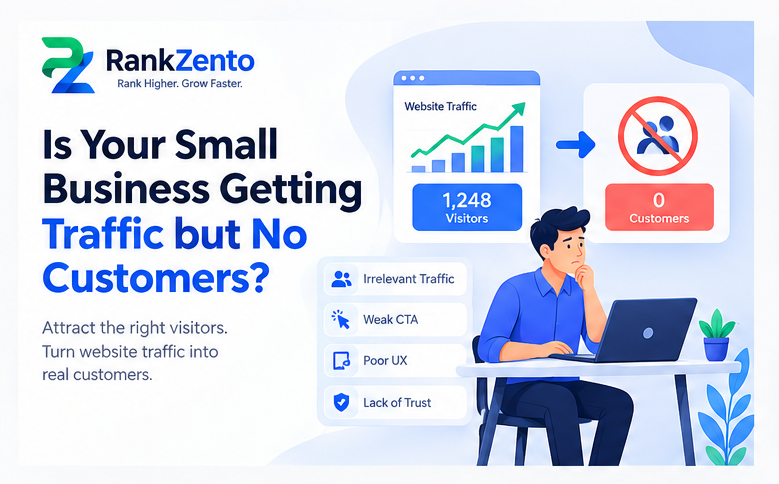
Getting traffic to your website is a positive sign, but traffic alone does not guarantee customers. If people are visiting your website but not calling, submitting forms, requesting quotes, booking services, or making purchases, something may be wrong with the journey from visitor to customer.
The issue could be irrelevant traffic, unclear messaging, weak calls to action, poor user experience, limited trust, or a mismatch between your content and search intent. A successful small business marketing strategy should not only attract visitors. It should help the right people understand your offer and take the next step.
At RankZento, we look at online growth from both sides: attracting relevant visitors and creating a clear path for those visitors to become leads or customers.
Why Is Your Small Business Marketing Not Converting Visitors?
Your marketing may be generating visibility without generating enough business results. This can happen when the people reaching your website are not ready to buy, your pages do not address their needs, or your website makes it difficult to take action.
For example, a business may rank for informational keywords that bring thousands of visitors but very few potential buyers. Another business may have strong commercial traffic but lose customers because its landing page is confusing.
Before trying to increase traffic, identify where the existing customer journey is breaking down.
Ask these questions:
- Are the visitors relevant to your business?
- Do your pages match their search intent?
- Can visitors quickly understand your offer?
- Is there a clear next step?
- Does your website provide enough trust?
- Are you tracking leads and conversions?
Answering these questions can reveal whether the problem is traffic quality, website experience, or conversion.
Is Your Website Traffic Reaching the Right Audience?
Not all website traffic has the same value. A visitor who is researching a topic is different from someone actively looking for a company to solve a problem.
For example, a roofing company may receive traffic from an article about common roof problems. That visitor may only want information. Another visitor searching for “roof repair company near me” has a much stronger service intent.
This distinction matters because increasing irrelevant traffic will not necessarily improve sales.
Review your Google Search Console data, analytics reports, keyword rankings, referral sources, and advertising campaigns. Look for the searches and pages that bring visitors who are most closely connected to your products or services.
The goal should be relevant website traffic, not simply a larger traffic number.
How Does Search Intent Affect Small Business Sales?
Search intent explains what a person wants when they enter a search query. Understanding it can directly affect how your content performs and how visitors move toward a purchase.
A user searching “what is SEO” is probably looking for education. Someone searching “SEO services for small business” may be researching providers. A person searching for a specific agency may already be closer to making contact.
Your pages should match these different needs.
Informational content should answer questions clearly. Service pages should explain what you provide. Commercial pages should help users evaluate their options. Conversion-focused pages should make the next action simple.
When your content matches intent, visitors are more likely to find the information they actually need.
Does Your Website Clearly Explain What You Offer?
Visitors should understand what your business does without having to search through several pages.
Your homepage and important landing pages should quickly communicate:
- What you offer
- Who you serve
- What problem you solve
- Why your solution is relevant
- What the visitor should do next
Avoid vague statements that could describe almost any company.
For example, “We deliver innovative solutions for modern businesses” does not tell visitors much. A clearer statement explains the service and the problem it solves.
Clear communication helps visitors decide whether they are in the right place.
Could a Weak Offer Be Hurting Your Small Business Sales?
Even when visitors understand your service, they may not see enough value to take action.
A strong offer does not have to mean discounts or aggressive promotions. It means clearly explaining what customers receive and why the service is relevant to their situation.
Consider answering:
- What does the customer receive?
- What problem does it solve?
- Who is the service for?
- What does the process involve?
- What happens after the customer makes contact?
The more important information a visitor has before making a decision, the less uncertainty they may experience.
Are Your Calls to Action Clear Enough?
A visitor may want your service but still leave if they cannot identify the next step.
Every important page should have a relevant call to action. Depending on the business, this could be:
- Request a quote
- Book a consultation
- Call the business
- Send an inquiry
- Schedule an appointment
- Purchase a product
- Request more information
The call to action should also match the page intent.
An informational article may need a softer next step, while a service page can provide a direct contact option.
The objective is to make the journey clear without overwhelming the visitor.
Does Your Website Provide Enough Trust?
Trust is an important part of online decision-making. People want to know that a business is legitimate, experienced, and capable of delivering what it promises.
Useful trust signals can include:
- Genuine customer reviews
- Relevant case studies
- Clear company information
- Professional contact details
- Author information
- Industry experience
- Helpful educational content
- Relevant certifications or credentials
- Transparent service information
For content, E-E-A-T principles can help demonstrate experience, expertise, authoritativeness, and trustworthiness.
Do not add exaggerated claims simply to make a business appear more established. Specific and verifiable information is more useful to both readers and search systems.
Could Poor Mobile Experience Be Losing Customers?
A website can look good on a desktop computer but still provide a poor mobile experience.
Visitors should be able to read content, navigate pages, complete forms, and contact the business without unnecessary difficulty.
Check whether:
- Text is easy to read
- Buttons are easy to tap
- Forms work correctly
- Menus are simple to use
- Important information is visible
- Pages load properly
- Contact options are easy to find
Mobile usability is particularly important for local and service businesses because many users search for businesses while using their phones.
Is Your Website Too Slow for Potential Customers?
Website performance can affect user experience. If a page takes too long to load, some visitors may leave before they see your offer.
Common causes of slow performance include:
- Large image files
- Unnecessary scripts
- Poor hosting
- Excessive plugins
- Unoptimized code
- Too many third-party resources
Review your most important landing pages and identify technical issues that may create unnecessary friction.
Do not focus only on achieving a perfect technical score. Focus on creating a fast and usable experience for real visitors.
Ready to Grow? Start Your Digital Marketing Journey With Us
Build a smart digital business strategy with Rank Zento, a trusted digital marketing agency that helps your business gain visibility, leads, conversions, and sustainable growth.
Is Your Content Matching What Customers Want?
Content can attract traffic without generating customers when it does not answer the right questions.
Before creating an article, identify the reason behind the search. Consider what the person wants to learn, compare, solve, or purchase.
For example, someone searching for “how to improve website speed” may need educational guidance. Someone searching for “website optimization services” has a different intent.
This is why keyword selection should not be based only on search volume. Relevance, intent, competition, and the relationship to your business also matter.
How Can Digital Marketing for Small Business Improve Customer Growth?
Digital marketing for small business can bring together multiple channels to help a business reach and convert relevant audiences.
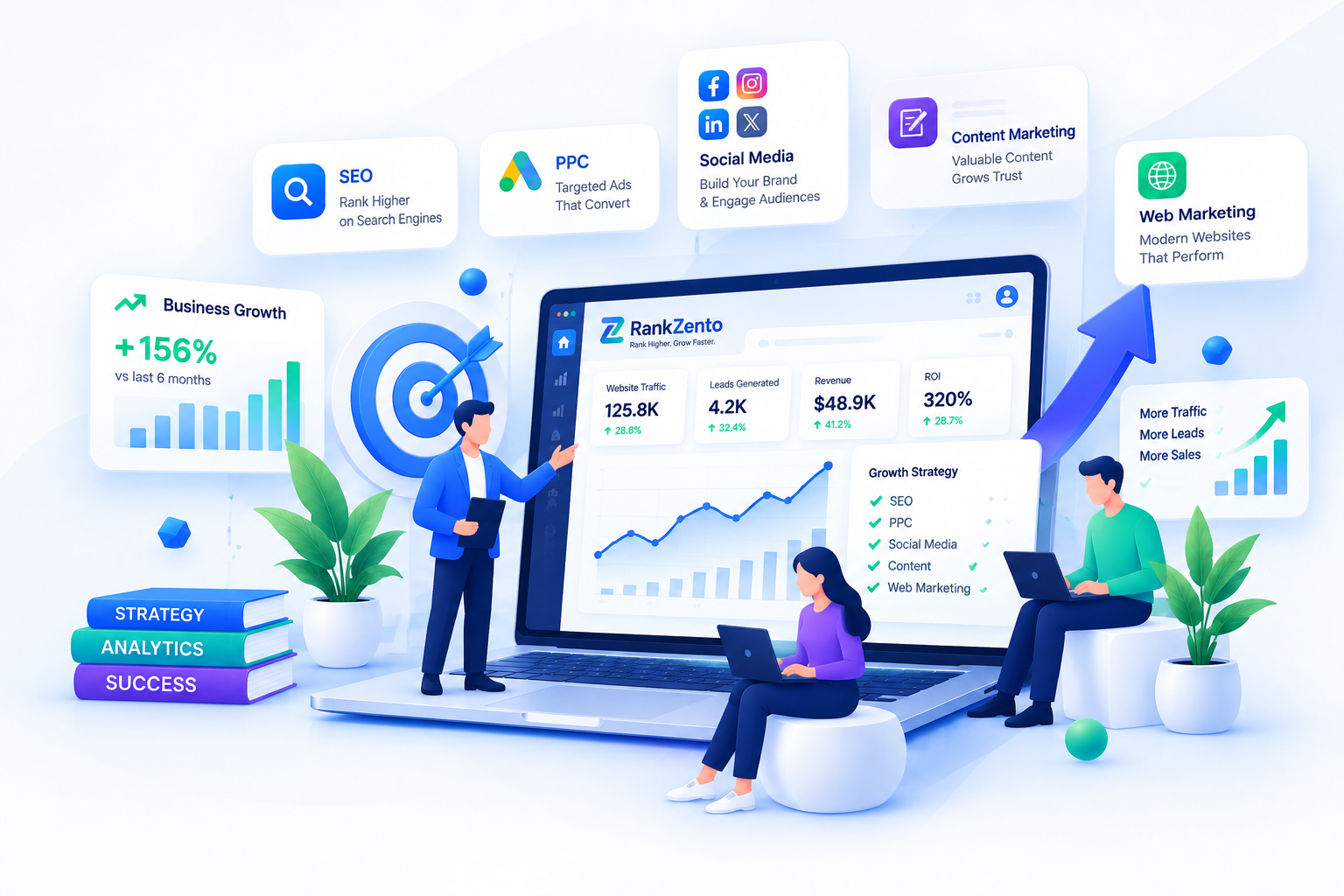
SEO can improve visibility for useful searches. Content marketing can answer customer questions. Social media can support awareness and engagement. Paid advertising can reach specific audiences. Website optimization can make it easier for visitors to take action.
The key is coordination.
A business may have good SEO but a weak website. Another may have strong social media activity but no clear conversion process. A third may spend money on advertising without tracking which campaigns generate qualified leads.
Digital marketing works more effectively when visibility, relevance, user experience, and conversion are considered together.
How Can Small Businesses Turn More Traffic Into Customers?
There is no single change that works for every business. Start by examining the complete path from search to conversion.
1. Find Your Highest-Traffic Pages
Identify which pages receive the most visitors.
Then determine whether these pages attract people who are relevant to your products or services.
2. Analyze Search Queries
Review the keywords and search queries associated with your pages.
Look for queries that show genuine interest in your services instead of focusing only on high-volume terms.
3. Improve Landing Pages
Your landing pages should answer the visitor’s main question quickly.
Make the headline clear, explain the value, provide supporting information, and include an appropriate call to action.
4. Strengthen Your Trust Signals
Add genuine evidence that helps visitors understand who you are and why your business is credible.
Reviews, case studies, author information, business details, and relevant credentials can all contribute to a stronger experience.
5. Simplify the Conversion Process
A visitor should not have to complete unnecessary steps to contact you.
Review forms, booking systems, phone links, checkout processes, and inquiry methods from a customer’s perspective.
6. Track Meaningful Actions
Do not measure success through traffic alone.
Track calls, form submissions, purchases, bookings, quote requests, and qualified leads where appropriate.
This gives you a clearer picture of whether your marketing is contributing to business results.
How Does Customer Acquisition Work for Small Businesses?
Customer acquisition is the process of attracting potential customers and turning them into actual customers.
For a small business, this journey can involve several stages:
- Awareness: A person discovers your business through search, social media, advertising, referrals, or another channel.
- Interest: The person visits your website or interacts with your content.
- Consideration: They compare your offer, research your business, read reviews, or look for additional information.
- Action: They call, submit a form, book a service, or make a purchase.
- Retention: A positive experience can encourage repeat business and referrals.
Understanding these stages helps businesses identify where potential customers are dropping out of the journey.
How Can You Improve Customer Acquisition Without Simply Increasing Traffic?
More traffic is not always the first solution.
If your current visitors are leaving because of unclear messaging, weak offers, poor mobile usability, or limited trust, sending even more visitors to the same experience may not solve the underlying issue.
Instead, examine your existing traffic first.
Identify which pages generate engagement. Determine which sources produce qualified leads. Find where users leave the website. Review your conversion process.
Once the foundation is working well, expanding SEO, content, paid advertising, social media, or other channels can create additional opportunities.
What Should You Measure Besides Website Traffic?
Traffic is useful, but it should not be the only metric.
Depending on your business model, consider tracking:
- Conversion rate
- Qualified leads
- Phone calls
- Form submissions
- Quote requests
- Bookings
- Purchases
- Cost per lead
- Lead sources
- Returning customers
These measurements provide more context than visitor numbers alone.
For example, 1,000 visitors with no qualified inquiries may not produce the same business value as 300 highly relevant visitors who generate genuine leads.
When Should a Small Business Focus on More Traffic?
Increasing traffic can make sense when your website already provides a strong experience for relevant visitors and has a working conversion process.
If your existing traffic is generating qualified leads but the volume is limited, expanding your keyword targeting and content strategy may create more opportunities.
However, if visitors are arriving and immediately leaving, investigate the reason before investing heavily in more traffic.
The goal should be sustainable growth through relevant visibility and effective conversion.
How Can RankZento Help With Small Business Marketing?
RankZento approaches online growth by looking at the complete customer journey instead of focusing on traffic numbers alone.
A business needs to be visible for relevant searches, provide useful information, communicate its value clearly, build trust, and give visitors an easy way to take action.
This means reviewing areas such as SEO, content, website structure, search intent, user experience, conversion paths, and performance data.
The right strategy will vary according to the business, target audience, industry, competition, website, and existing digital presence.
RankZento’s approach is centered on identifying the specific gaps that may be preventing online visibility from turning into meaningful business opportunities.
What Should You Do If Your Website Gets Traffic but No Customers?
Start with the basics.
Check whether your traffic is relevant. Review your search intent. Make sure visitors understand your offer. Improve your landing pages. Strengthen trust signals. Make calls to action clear. Test your forms and contact options. Check mobile usability and website performance. Then measure the actions that actually matter to your business.
You do not always need more visitors. Sometimes you need to make better use of the visitors you already have.
Final Thoughts
Website traffic is only one part of online growth. If your small business receives visitors but struggles to generate customers, the problem may be somewhere between search visibility and conversion.
Look at the complete journey. Are you reaching the right audience? Does your website answer their questions? Is your offer clear? Do visitors trust your business? Can they easily contact you or purchase from you?
A strong small business marketing strategy connects these elements instead of treating traffic as the final goal.
At RankZento, the focus should be on creating a digital presence that is useful to people, understandable to search engines, and structured around real business goals.
The ultimate objective is not simply more website visitors. It is helping relevant visitors move from discovering your business to becoming genuine leads and customers.
Frequently Asked Questions
Why does my small business get traffic but no customers?
Common reasons include irrelevant traffic, weak search intent targeting, unclear website messaging, poor user experience, weak calls to action, limited trust signals, and a difficult conversion process.
How can I turn website traffic into customers?
First identify whether your visitors are relevant. Then improve your landing pages, offer, trust signals, calls to action, mobile experience, and conversion process. Track leads and sales to measure the impact.
Is more website traffic always better?
No. Relevant traffic is generally more useful than traffic that does not match your products, services, or target audience.
What is the role of SEO in small business marketing?
SEO helps businesses become visible for relevant searches. Effective SEO considers search intent, useful content, technical performance, website structure, and the needs of the target audience.
How can digital marketing for small business generate more leads?
A combination of SEO, content, social media, paid advertising, website optimization, and conversion tracking can help businesses reach relevant audiences and create clearer paths toward inquiries and sales.
What is customer acquisition?
Customer acquisition is the process of attracting potential customers and converting them into actual customers through channels such as search, advertising, social media, content, referrals, and direct outreach.
Should I focus on SEO or paid advertising?
It depends on your goals, audience, competition, budget, and timeframe. SEO can support organic visibility over time, while paid advertising can provide targeted exposure. The right mix depends on the business and its customer journey.